Wednesday, October 7, 2015

Getting the most from your manure: Dealing with Uncertainty and Variability of Manure

A couple weeks ago I wrote about how today’s spreaders are helping you control the amount of manure going down on every acre better than ever before, today I wanted to follow up on that a bit. Unfortunately, manure is a variable fertilizer – its nutrient content varies from year-to-year or farm-to farm, the availability of some of the nutrients within the manure is influenced by the weather that year, and our ability to control how uniform it is applied is dependent on both our equipment and the field conditions. Understanding the sources of variability in manure and figuring out the best ways to manage them are critical to making the best agronomic and environmental use of manure resource.

There are three main sources of variability and uncertainty when using manure as a fertilizer for crop production. These are:
·         The nutrient content of the manure
·         The availability for the manure nutrients to the crop
·         Application variability

If you don’t account for this variability, you can end up applying too much or too little manure, both of which are costing you profits. Applying too little manure can lead to reduced crop because of nutrient deficiency while too much manure wastes nutrients and could negatively impact water quality.

When it comes to handling uncertainty in the nutrient content of manure, collecting a good, representative sample is the key. By sampling, you know the NPK contents of the manure and make a more informed decision. Certainly, some uncertainty still remains as there is nutrient variation from load to load based on the effectiveness of different agitation and mixing strategies, but overall you can be much more confident about the nutrients levels that are in the manure.

The next issue is availability for the manure nutrients to the crop. Here I’m using availability to refer to both the fraction of nutrients that will be mineralized and supply due to losses that occur at the time of application. In general, this source of uncertainty is larger for nitrogen then either phosphorus or potassium, as the P and K in manures are usually readily plant available whereas some of the nitrogen compounds are more difficult to break down to the forms plants can use. Additionally, as nitrogen has a gaseous form (ammonia), whereas P and K don’t, it is much more prone to losses during application. In terms of minimizing uncertainty from these components there aren’t always easy answers. The amount of nutrients that are potentially plant available or dependent on properties of the manure, the soil you are applying to, and the weather during that growing season. The ISU publication PMR 1003 gives some recommendations on first year availability of manure nutrients based on different manure types and this is a great starting point. The rest of the variability is harder to control as the weather is unpredictable and it play a role, as cool years promote slower mineralization than warmer years. However, when it comes to ammonia volatilization injection or incorporation is one way to lower the potential variability in nutrient loss. With typical injection or immediate incorporation typically you only lose about 0-5% of the applied nitrogen (so 5% uncertainty in nitrogen supply), but if you broadcast a liquid manure you’ll typically lose 10-25%. This means that your uncertainty in the amount of nitrogen you are supplying is already 15%.

Finally, the third area to think about is variability in your application. This encompasses both the variability in your manure as it comes from the storage and the uniformity of the spreading equipment. Certainly agitation of liquid manure can help improve uniformity, but we’ve all seen that often times the last load out of a pit has a thicker consistency than the first load. With solid manure this may be even more difficult, the manure packed in the back of our storage structure might have been the first we collected after land application last year, but there usually aren’t many good ways to mix that with our freshest manures that are being produced during application.

Another part of this equation is how accurately can you hit your planned rate and how consistently do you maintain this rate? If your goal is to apply 3000 gallons an acre how close are you to this rate and how does it fluctuate as you move through the field. If you are applying using tankers how quickly does your equipment lock on to the rate and what distance does this translate to in your field where you weren’t locked on yet? If you are using a dragline system, how consistent is your flow rate? We also need to ask how uniform our spread pattern is. We discuss this in terms of solid manure application as we can see the pattern on the soil surface, but we should think about liquid spreader the same way. Does each injector get the same amount of manure, what happens if you’re on a hill and the spreader is at an angle.


To get the most value from the manure we have to do our best to minimize the variability and uncertainty in all parts of our manure application program. As you tackle and control the uncertainty and variability in one aspect of your manure system it will provide a clearer picture of the variability and uncertainty with other components of your manure system.

In addition to this there are at least two additional techniques you can use to reduce the to reduce the risk that uncertainty and variability provide in your fertility program. The first is to consider using split nitrogen application with manure in the fall (perhaps 50-75% of your planned nitrogen need) and then supplementing this in the spring. This technique helps reduce risk from uncertainty with nutrient availability in the manure as it provides a second, mineral fertilizer that is quickly available. It can also reduce the uncertainty associated with uneven application as by providing a second application of fertilizer we minimize the potential of missing the same spot twice (i.e., reducing streaking from non-uniform manure application). Another option is to focus on crop rotations – rotations with legumes (in particular alfalfa or even soybean) reduce the sensitivity of the following crop (often corn) to nitrogen rate. Often times we’ve referred to this as a “N credit” (although it may be a bit of a misnomer as the crop doesn’t always add more nitrogen than it removes). However, with legumes in the rotation we tend get soils that are more capable of buffering the nitrogen supply in the soil to meet crop needs, making it less sensitive to the nitrogen we are adding with manure.


Wednesday, September 23, 2015

Not Your Grandpa’s Manure Spreader

Another manure application season is arriving, so what better way to prepare than to talk a bit about manure spreader technology? At first, manure spreaders might seem pretty simple – they are used to get manure from point A (the barn or barnyard) to point B (the field). However, they have to do so much more than that.  Manure spreaders not only have to get manure from the barn to the field, but once they are in the field they have to evenly spread that manure over the field.


The early history on manure spreaders is a little shaky, but the general story is they were originally horse drawn and had to be manually unloaded using a pitchfork. Eventually Joseph Kemp, who is credited with developing the first automated spreader (in 1875) developed a new version that unloaded itself. This spreader essentially left all the manure right behind itself, not the most desirable pattern, but definitely better than the backbreaking work of pitching the manure off. Joseph Kemp then sold his design to International harvester in 1906.


 The next leap forward was by Joseph Oppenheim, who’s “New Idea” added paddled beaters at the back that shredded and flung the manure to the side. This created a “widespreading” pattern that more uniformly spread the manure over the soil surface. A lot has happened since then; we switched from horses to tractors for power, made bigger and bigger spreaders, and switched steel wheels to rubber. However, we still often deal with the same challenges - trying to get the right amount of manure applied to a field, getting the manure application as uniform as possible, and trying to do it all as quickly so we can start after our soils have cooled and before they are frozen.

The spreaders we have today have incorporated new techniques to help in hitting the application rate and controlling how much manure is applied, and that is the part I’m going to focus on. I’m going to look at slurry spreaders during this discussion. The rate control consists of 4 basic parts: a rate controller (the brains of the system), a flow meter (the sensing element that measures the variable we are trying to control), a GPS unit to map and sense tractor speed, and then a means of adjusting the flow (often a valve in the system or a hydraulically speed controlled pump). Below I have a schematic that that walks through the parts of the system and how they work with each other. The brown arrows represent manure flows and the black line represent information flows, which are handled electronically or hydraulically.


So the system starts with knowing what rate application rate we are trying to achieve, let’s say its 2500 gallons an acre. We need to enter this into the on-board controller. The controller also needs information on the size of our tool bar. Let’s say it is 8 injectors at 30” centers. This means with every pass we’d cover 20 feet. Finally, the GPS feeds the tractor and spreader speed into the controller. Let’s say it gets a reading of 7.5 mph (660 ft/min). The controller does a little math and says at this speed we are covering 13,200 square feet per minute (or about 0.303 acre/min), so to achieve our desired application rate we need a flowrate of 757.6 gallons per minute. As the system starts up the pump will push some flowrate through to the application toolbar, let’s say the flowmeter reads 1000 gpm. The controller than sends a signal to the actuator to slightly close the valve. It keeps doing this until the desired flow rate matches what we are trying to achieve. Pretty sophisticated controls, but necessary to make sure we are getting the most from our manure fertilizer.

So what’s this look like on a real manure spreader. The picture below shows the side view of a Houle spreader. It is not visible in the front in this picture, but the next one shows the pump in the front of the spreader. As we start applying this pump kicks on and starts manure moving through the pipe on the top of the tank. The grey portion in the pipe, that’s the flow meter, it’s constantly measuring the flow rate of manure and sending this information to the controller in the cab. The controller uses this information, along with the speed of the tractor, the desired application rate, and the width of the implement to determine whether to open or close the valve. You can see the valve and actuator; in this case it a hydraulically closed actuator that opens or closes the valve.

Profile view of of manure spreader.

PTO driven pump on the front of the manure spreader.

In cab controller that electronically opens and closes the valve to match that actual flow rate to the desired rate.

Friday, September 11, 2015

The science behind 50-degree soil and nitrogen application

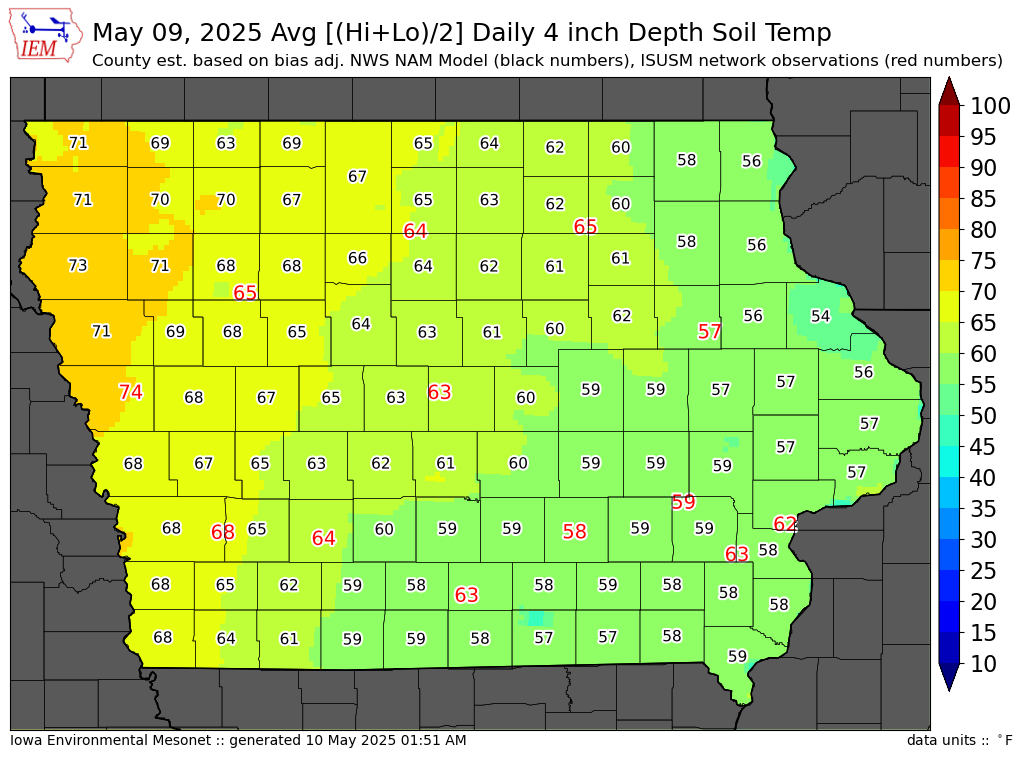
Every year we hear a chorus of reminders to wait until soil temperatures at the 4-inch depth are 50°F and trending cooler before applying anhydrous ammonia, and those of us in the manure world tend to echo these comments. That is if you are applying an ammonia rich manure, liquid/slurry hog manure wait until soils start to cool before applying. So, what is the science behind this recommendation, especially for manures?

This recommendation is based on the potential for nitrogen loss. Remember, there are a few forms of nitrogen that can be applied or are found in soils these include ammonia/ammonium, nitrate, and organic nitrogen. Of these forms, all forms can be lost, but ammonia and nitrate tend to be the most mobile.

Ammonia is lost as a gas, so if we are using an ammonia/ammonium fertilizer (like swine manure) it’s important to get the fertilizer into the soil quickly where the ammonia will react with the soil particles and be held, rather than letting it sit on the surface where some of it can be lost to the air. This is why injection or immediate incorporation can be a great technique for getting the most from your manure, it makes sure that we aren’t immediately losing some portion of the nitrogen we are applying.

Nitrate on the other hand is lost with water, especially water moving through the soil to groundwater or tile drains. Nitrate is super soluble, so if water is moving and we have nitrate in our soil, it is probably moving with the water. We tend to have larger rains in the spring coupled with wetter soils from snow melt, this means that if the nitrogen we applied is in the nitrate form there is a high opportunity for it to be lost in the spring.

When it comes to manures, it’s pretty much nitrate free when we apply it, but microbes in the soil will process it and turn it to nitrate. The activity level of these microbes is controlled by how much ammonia is present, the amount of water and oxygen in the soil, and the soil temperature. Although all these variables are important, for now I’m going to focus just on temperature. A good rule of thumb is that microbial activity will double for every 18°F increase in temperature (so if our soil is at 68°F those microbes will be turning the ammonia in the manure into nitrate at about 2x the rate they would if our soil was at 50°F). Often times this means that not only will the microbes have more time to cause the conversion to nitrate, but they might be doing it much faster than if fertilizer application had waited.

So what’s this look like? I did a little exercise where I calculated a term like a degree-day, I’m going to call it activity-days. It is an index that takes into account how many days the microbes in the soil had access to the nitrogen fertilizer and how active they would have been on those days (based on the temperature of the soil). I then took the ratio of how much more nitrification you might expect if you applied at a certain day compared to the amount that you might expect if you applied when the soil reached 50°F. I did this for 12 sites (with a few of these sites having data from a couple of years) and plotted out the relative risk of nitrification compared to application date. What you can see pretty clearly is we start out with a steep slope (relative risk of nitrification decreasing quickly) until we high a relatively risk of around 1 (that would be the soil at a temperature of 50°F). Once with hit this point, generally around the first week of November the relative risk of nitrification decreases much more slowly.


Does nitrogen becoming nitrate mean we are going to lose it? No, it takes rainfall or snowmelt in the spring that will cause a leaching event, but it does increase the risk of loss. Certainly there is a balance between making sure we get our manure applied before the soil freezes  and applying two early, but hopefully the graph above illustrates a bit behind the science of the 50°F and cooling recommendation.


As a reminder, Iowa State University Extension and Outreach maintains a statewide real-time soil temperature data map on their website that ag retailers and farmers can use to determine when fall applications are appropriate. The website can be found at http://mesonet.agron.iastate.edu/data/soilt_day1.png

Tuesday, August 25, 2015

Can application of sand laden manure impact soil texture?

Soil texture and soil structure are properties of a soil that have major effects on a soils behavior, influencing important properties like the soil’s water holding capacity, its ability to retain and supply nutrients, the rate of water movement through the soil, and how much nutrient leaching will occur under different weather conditions.

Soil texture has is the relative proportions of sand, silt and clay sized particles in a soil. Knowing the amount of these particles in the soil lets us group the soil into a texture class. This has turned out to be extremely useful concept as just by knowing the textural class of a soil we understand many of its properties. For example sand instantly understand that the soil will have low water holding capacity, that water can move through it very quickly, and nitrogen will be very susceptible to leaching.

Of all the particles, clay tends to be the most important in determining the soil properties. This can be seen b examining the soil triangle as only about 25% of the soil needs to be clay to have “clay” included in the soils name, where as it takes 40-50% of the soil to have silt or sand included in the soil texture name. The reason this occurs is because the surface area of the particle has a major influence on this properties, and because clay sized particles are so much smaller than sand particles, the same mass of clay particles as sand will have more than a thousand times the total surface area of the particle.

 Soil structure refers to the arrangement of soil particles into groupings, or aggregates. Soil aggregation is an important indicator of workability to the soil and is often used synonymously with the term tilth. The type of structure that develops is dependent on lots of factors – the soil texture, the amount of organic matter, roots, and even the type of clay particles present.


So where am I going with this and how does it relate to manure? Well, this question came up because of sand bedding for dairy cows. The question was how does continually application of sand laden manure impact the soil and could it even change the texture?

So a few facts to get us started, the first thing question we need to know is how much soil is there in an acre? To make this calculation we need to know how deep we are considering, I’m going to pick 4 inches as most tillage equipment would work to this depth. Assuming a soil density of around 75 lb/ft3 (1.2 g/cm3) this means we’d have about 540 tons of soil in an acre.

The next question becomes how much manure are we going to put on and how often. Although its hard to pick a typical manure, I’d estimate sand laden dairy manure to be around 5 lb P2O5/ton and have about 300 lb of sand per ton. If I was applying to provide a year’s worth of P2O5 I’d want to put on around 60 lbs, which means I’d be applying about 12 tons of manure, or about 2 tons of sand per year. Will this impact my soil?

Say that our soil was a loam (20% clay, 40% silt, 40% sand). This means that right now my soil has 108 tons of clay, 216 tons of silt, and 216 tons of sand. If I added 2 tons of sand, my soil texture would change to 19.9% clay, 39.9% silt, and 40.2% sand; an imperceptible change (certainly not one we’d pick up by soil testing as the variability in collecting a sample is much larger than that). However, keep doing this for 84 years, and your soil texture would be 15% clay, 29% silt, and 56% sand – a sand loam soil.


Is this a long time, most certainly – is the soil better or worse than it was before? It’s hard, to say as it depends on longs of factors, like the soil texture we started with, our climate, our crop rotation, and what soil conditions the plant we are growing most prefers, but it is different. If you asked me if I was more concerned about adding two more tons of sand of soil to my acre of field or about losing two tons of soil to erosion, I’d most certainly be concerned about the erosion; however, it’s important to think about our soils long term and how we can best manage those resources to meet our production and sustainability goals.

Thursday, August 6, 2015

The Scoop on (Cow) Poop


I saw this video and had to share. It is well made and does a nice job illustrating the manure management side of farming.

Tuesday, July 28, 2015

Hydrogen Sulfide and Manure Safety

In the last month, we've had two tragic accidents related to manure and repairs in a barn. In both cases, a father and son were working on some repairs in the barn near the manure. One of the two either then passes out and falls in the manure or enters the manure and passes out. The other then dives in to attempt to pull the other to safety; neither survives. These are tragic reminders that on the farm we need to think about safety every day in all our activities, especially those dealing with manure.

The decomposition of organic matter in manure results in the release of several gases, ammonia, carbon dioxide, methane, and hydrogen sulfide among them. Although all are potentially dangerous, hydrogen sulfide tends to be the one of most concern in these cases. Hydrogen sulfide has an intense rotten egg smell, so it is relatively easy to detect its presences, even in very low concentrations. However, after breathing it for a short time your sense of smell will become fatigued and you lose the ability to detect it. Just as importantly, since we can smell it at such low levels, there is not a clear indication of when it reaches a potentially hazardous conditions that we can detect without the use of analytical instruments.

In many animal housing facilities, the manure pit is often located below the facility floor. Within these buildings these gases are generally detectable in low concentrations throughout the year; however, under some conditions, such as manure agitation, the gases can be released rapidly from the manure and reach potential toxic levels for people and animals. Even in other systems, where the manure is stored outdoors, toxic levels of hydrogen sulfide can result near and in the manure storage under certain conditions; mostly limited to periods of manure disturbance such as agitation.

Generally, we use the barns ventilation system to try to control the level of these gases within the barn. Barn ventilation systems can be relatively complex, they consist of a controller that monitors temperature (and potentially other variables) within the barn and  then turns on and off banks of fans,  raise or lower ventilation curtains, and control when heaters run. Although ventilation systems can run in numerous ways, a common system in the US is the use of pit fans to provide minimum ventilation requirements, end wall fans for more ventilation, and then sidewall curtains that can be brought up and down to let a breeze blow through the barn and facilitate greater air exchange.

Example of a typical swine barn in Iowa. You can see the barn has an end wall fan for ventilation and is curtain sided. Curtains are raised and lowered to control the barns ventilation. What you might not immediately notice is that underneath the curtain there are a series of pump-out ports (see the lower right of the picture).

The pit fans provide minimum ventilation requirements for the animals and run almost continuously to help draw ammonia, methane, carbon dioxide, and hydrogen sulfide produced by the manure within the barn.

In the last few years we have been seeing higher sulfur levels in our manure. For example, swine manures used to average about 3 lbs sulfur per 1000 gallons of manure, but recent sample collection from 70 farms within Iowa showed we are currently averaging closer to 9 lbs of sulfur per 1000 gallons. This means our potential for larger sulfur releases are higher and to keep everyone (and pig safe) we will have to put a greater focus on safety.

Friday, July 17, 2015

Manure: a complete, but not balanced fertilizer

 We all know that manures can serve as valuable soil amendments due to its potential to improve soil quality and tilth while proving nitrogen, phosphorus, potassium, sulfur, and numerous other plant nutrients, but in not properly managed and land applied it can also result in negative environmental consequences. Overall, the vast majority of farmers do a great job thinking about how they can best use manure in their farming enterprise and implement techniques and practices to help capture the most benefit as they can. However, as I’ll discuss here, this isn’t always as easy as it sounds.

A comment I often hear about manure is that it is a complete fertilizer. When people say this they usually mean that manure has all the essential nutrient needed for crop growth; however, just because it has the right nutrients in it, doesn’t mean that they are available at the ratio our plants want. This adds some unique challenges to manure management that just don’t exist with other fertilizer options. Take for example a field that needs 150 units of N. If we go down to the co-op and pick up some anhydrous ammonia we can go to our field and put on the needed nitrogen; however, if we use manure to provide the nitrogen we’ll also get some phosphorus and potassium along with it. That is manure is a packaged deal, we can just pick out a chunk of nitrogen and say I’ll take this and leave the rest. The nutrients come as a package deal.

This in itself isn’t an issue, but rarely is the nutrient ratios (N:P:K) in manures such that it matches with crop need. This can occur for a variety of reasons, but the most common have to do with losses of nitrogen during storage. This results in a situation where extra phosphorus ends up getting applied to reach the crops nutrient need. This may not be an issue if we rotate fields that receive manure and wait until our crops have reviewed the extra phosphorus we ended up applying, but this might require using alternative nitrogen sources for several years as we wait for our crop to remove some of the phosphorus.

Alternatively, sometimes when manure is stored outside soluble nutrients, like potassium, may be lost from the manure to a greater extent than more stable nutrients like phosphorus. If the manure is then applied at a phosphorus limiting rate we might end up removing more potassium with the harvested crop than we applied. Repeat this a few times and our soils could even become potassium deficient.


So the next time you hear someone mention manure is a complete fertilizer, just remember that that may not mean it is a balanced fertilizer. Soil testing can be a great tool to help you track what’s happening to phosphorus and potassium levels in your soil, and can serve as a great piece of information when you are planning the best ways to get the most from your manure.