Wednesday, November 18, 2015

Emerging Issues in Manure Management: Are manures increasing antibiotic resistant bacteria?

Did you know it is the World Health Organizations Antibiotic Awareness Week? In light of this, I decided it was a good week to look at antibiotic resistance bacteria in manures. Now this isn’t a topic I consider myself and expert on so I’m going to be borrowing heavily from my college at Iowa State, Dr. Michelle Soupir.

Antimicrobials, such as antibiotics, are used in the livestock industry at therapeutic levels for disease treatment. Once the antibiotic has been administered, the animal will begin to metabolize it (break it down), but not all of it is metabolized, some is excreted with the feces and urine, ending up mixed with the manure.  For example, in the case of tylosin about ¾ of the mass administered to an animal ends up in the manure.

Why does this matter? Well once these compounds are in the manure they put a selective pressure on the microbes in it to become resistant to that compound. It is sort of like this, if its cold outside you can stand outside and shiver or you can put a jacket on. For microbes it’s sort of the same thing; the presence of that compound might negatively impact most of the microbes, but perhaps a few of them will figure out to put a jacket on (become resistant to that antibiotic). Then when the manure is land applied as a fertilizer, these resistant bacteria enter the environment. If it happens to be a microbe that makes people sick and they come into contact with it there is a chance that our normal antibiotics might not be as effective for this guy, because it already has some built up tolerance to it. Sure, there are lots of ifs in this case – are they in the manure to start with, how long do they last, does the animal and human antibiotic even work in the same way (similar mechanisms) – but that’s what people are trying to find out.

Picture of Enterococcus

So in a recent study Dr. Soupir performed she tested how swine manure application (fall applied swine manure at 168 kg N/ha, or about 150 lb N/acre compared to spring injected UAN) and tillage practices (chisel plowing versus no-till) impacted the persistence and transport of enterococci; both total enterococci and those resistant to tylosin (a type of bacteriosat that was used at the farm the manure was obtained from).


So they measured lots of things in this study but what we are going to focus on is enterococci (and tylosin resistant bacteria) in the manure (at the time of application), in the soil (both in the fall after manure was applied and in the spring), and in tile water over the following growing season. They found that the manure had between 90,000 and 570,000 colony forming units per gram of manure and that between 70-100% of these bacteria were resistant to tylosin. When it came to the soil samples, they tested both in the manure application band, outside the manure application band, and in the control plots that didn’t receive manure. Not surprisingly, enterococci concentrations were the greatest in the manure injection band, and lowest in the control soils that didn’t receive manure. Concentrations of enterococci between the manure bands were similar to the non-manured soils. Over the winter, enterococci concentrations decreased by about 70 and by the time the manure had been in the soil for a year had returned to levels equivalent to soils not receiving manure. No difference in enterococci concentrations in the tile drainage water were found.


So where does this leave use? At least during this study, when weather conditions were drier than normal for Iowa, it doesn’t appear that manure injection changed the risk of to water quality. However, different weather conditions where it is wetter during and after manure application, may impact these results.

A publication detailing this study is available at:
http://lib.dr.iastate.edu/cgi/viewcontent.cgi?article=1819&context=abe_eng_pubs
Check it out if you are interested in learning more.

Wednesday, November 11, 2015

Perennial Forages on the Landscape: Do ruminants lead to alfalfa?

I grew up on a small dairy farm in Central Wisconsin – we milked about 40 cows and had 110 acres where we grew mostly corn and forages. Our forages were always a mix; alfalfa-grass mixes (seeded with an oat covercrop that was turned into oatlage that first year) in our “good” fields, clover mixes in our wetter fields where alfalfa didn’t do as well. In some years maybe even some sorghum sudangrass (often in a hayfield that winter killed that we had to tear up or that corn field that didn’t get planted because it was too wet).

So why an I reminiscing about perennial forages? The Iowa nutrient reduction strategy (Reducing Nutrient Loss: Science Shows What Works - https://store.extension.iastate.edu/Product/Reducing-Nutrient-Loss-Science-Shows-What-Works) says that adding 2 years of alfalfa to a 4 or 5 year rotation can reduce nitrogen loss by 42% and it will help reduce soil and phosphorus loss as well. It provides perennial ground cover for periods of the rotation after all. So the questions that has been on my mind is what would motivate farmers to raise more alfalfa (or actually any perennial forage)? Has it been replaced by another forage like corn silage? I ask these questions because at least one way of potentially getting more alfalfa on the landscape is to encourage more ruminant animal production as they can use the forage to make human food – meat and milk.

To get us started on this conversation I looked at survey data from the National  Agricultural Statistics Service. The first thing I pulled was alfalfa acres by year from 1950 through 2015 in both Iowa and Wisconsin. Back in 1950 there was about 4 million acres of alfalfa in each state, now there is a little over 1 million in Iowa and 1.6 million acres in Wisconsin. When I look at this graph I see some similarities – both states have seen pretty drastic reduction in alfalfa acres over the 60 years shown, but one big difference. Iowa started losing alfalfa acres before Wisconsin did. Iowa alfalfa acres have been on the decline since about 1955, while Wisconsin stayed pretty steady in alfalfa acres until about 1990. So why have these acres been on the decline?


To supplement this I also took a look at corn silage acres, hypothesizing that if we were going to grow less alfalfa perhaps corn silage was replacing it in rations. It was interesting to me that I didn’t really find this at all – Wisconsin corn silage acres today are almost the same as they were back in 1950, and while Iowa’s corn silage acres are also similar to their 1950s levels they are still well below the levels we saw throughout the 60’s, 70’s, and early 80’s. Apparently that wasn’t the missing piece to the puzzle, but then I looked at total corn silage production (tons raised per year), and it held a partial answer – for Wisconsin at least. Though corn silage acres haven’t increased, corn silage production had, especially since 1990 (when we started seeing less alfalfa acre). If you plot alfalfa acres in Wisconsin versus corn silage production you get a petty strong relationship of alfalfa decreasing with more corn silage -  a pretty good indication that corn silage is replacing alfalfa, maybe not on the landscape but in our dairy rations. Better corn silage yields are freeing up land that had been used for alfalfa to grow other crops. So this answers part of my question – more ruminants won’t necessarily lead to more alfalfa on the landscape – but also says it could, we just have to understand what drives the decision of alfalfa versus corn silage a little better (another topic for another post though).


However, it did not answer my question about alfalfa production in Iowa; but if we look at cattle on feed and corn silage production in Iowa we can see that they do trend together. As cattle on feed peaked in the early 1970s corn silage production was growing and peaked shortly after was well. Indicating that corn silage and cattle were linked. This doesn’t explain where our alfalfa acres went, but it does show that  more ruminants won’t necessarily lead to more alfalfa. There are other important factors in deciding between alfalfa and corn silage.


So where do we go from here? Adding alfalfa (or other perennial forages) to the landscape can have numerous water quality benefits and could potentially open additional opportunities for feeding more ruminants. However, based on history it appears the opposite approach, getting more ruminants on the landscape may not have the same effect. That is just because we have more ruminants doesn’t guarantee more perennials for forages. If we are going to strive for more perennials, ruminants can be part of the answer, but it will also require a conscious decision to choose the perennial instead of corn silage.

Wednesday, October 7, 2015

Getting the most from your manure: Dealing with Uncertainty and Variability of Manure

A couple weeks ago I wrote about how today’s spreaders are helping you control the amount of manure going down on every acre better than ever before, today I wanted to follow up on that a bit. Unfortunately, manure is a variable fertilizer – its nutrient content varies from year-to-year or farm-to farm, the availability of some of the nutrients within the manure is influenced by the weather that year, and our ability to control how uniform it is applied is dependent on both our equipment and the field conditions. Understanding the sources of variability in manure and figuring out the best ways to manage them are critical to making the best agronomic and environmental use of manure resource.

There are three main sources of variability and uncertainty when using manure as a fertilizer for crop production. These are:
·         The nutrient content of the manure
·         The availability for the manure nutrients to the crop
·         Application variability

If you don’t account for this variability, you can end up applying too much or too little manure, both of which are costing you profits. Applying too little manure can lead to reduced crop because of nutrient deficiency while too much manure wastes nutrients and could negatively impact water quality.

When it comes to handling uncertainty in the nutrient content of manure, collecting a good, representative sample is the key. By sampling, you know the NPK contents of the manure and make a more informed decision. Certainly, some uncertainty still remains as there is nutrient variation from load to load based on the effectiveness of different agitation and mixing strategies, but overall you can be much more confident about the nutrients levels that are in the manure.

The next issue is availability for the manure nutrients to the crop. Here I’m using availability to refer to both the fraction of nutrients that will be mineralized and supply due to losses that occur at the time of application. In general, this source of uncertainty is larger for nitrogen then either phosphorus or potassium, as the P and K in manures are usually readily plant available whereas some of the nitrogen compounds are more difficult to break down to the forms plants can use. Additionally, as nitrogen has a gaseous form (ammonia), whereas P and K don’t, it is much more prone to losses during application. In terms of minimizing uncertainty from these components there aren’t always easy answers. The amount of nutrients that are potentially plant available or dependent on properties of the manure, the soil you are applying to, and the weather during that growing season. The ISU publication PMR 1003 gives some recommendations on first year availability of manure nutrients based on different manure types and this is a great starting point. The rest of the variability is harder to control as the weather is unpredictable and it play a role, as cool years promote slower mineralization than warmer years. However, when it comes to ammonia volatilization injection or incorporation is one way to lower the potential variability in nutrient loss. With typical injection or immediate incorporation typically you only lose about 0-5% of the applied nitrogen (so 5% uncertainty in nitrogen supply), but if you broadcast a liquid manure you’ll typically lose 10-25%. This means that your uncertainty in the amount of nitrogen you are supplying is already 15%.

Finally, the third area to think about is variability in your application. This encompasses both the variability in your manure as it comes from the storage and the uniformity of the spreading equipment. Certainly agitation of liquid manure can help improve uniformity, but we’ve all seen that often times the last load out of a pit has a thicker consistency than the first load. With solid manure this may be even more difficult, the manure packed in the back of our storage structure might have been the first we collected after land application last year, but there usually aren’t many good ways to mix that with our freshest manures that are being produced during application.

Another part of this equation is how accurately can you hit your planned rate and how consistently do you maintain this rate? If your goal is to apply 3000 gallons an acre how close are you to this rate and how does it fluctuate as you move through the field. If you are applying using tankers how quickly does your equipment lock on to the rate and what distance does this translate to in your field where you weren’t locked on yet? If you are using a dragline system, how consistent is your flow rate? We also need to ask how uniform our spread pattern is. We discuss this in terms of solid manure application as we can see the pattern on the soil surface, but we should think about liquid spreader the same way. Does each injector get the same amount of manure, what happens if you’re on a hill and the spreader is at an angle.


To get the most value from the manure we have to do our best to minimize the variability and uncertainty in all parts of our manure application program. As you tackle and control the uncertainty and variability in one aspect of your manure system it will provide a clearer picture of the variability and uncertainty with other components of your manure system.

In addition to this there are at least two additional techniques you can use to reduce the to reduce the risk that uncertainty and variability provide in your fertility program. The first is to consider using split nitrogen application with manure in the fall (perhaps 50-75% of your planned nitrogen need) and then supplementing this in the spring. This technique helps reduce risk from uncertainty with nutrient availability in the manure as it provides a second, mineral fertilizer that is quickly available. It can also reduce the uncertainty associated with uneven application as by providing a second application of fertilizer we minimize the potential of missing the same spot twice (i.e., reducing streaking from non-uniform manure application). Another option is to focus on crop rotations – rotations with legumes (in particular alfalfa or even soybean) reduce the sensitivity of the following crop (often corn) to nitrogen rate. Often times we’ve referred to this as a “N credit” (although it may be a bit of a misnomer as the crop doesn’t always add more nitrogen than it removes). However, with legumes in the rotation we tend get soils that are more capable of buffering the nitrogen supply in the soil to meet crop needs, making it less sensitive to the nitrogen we are adding with manure.


Wednesday, September 23, 2015

Not Your Grandpa’s Manure Spreader

Another manure application season is arriving, so what better way to prepare than to talk a bit about manure spreader technology? At first, manure spreaders might seem pretty simple – they are used to get manure from point A (the barn or barnyard) to point B (the field). However, they have to do so much more than that.  Manure spreaders not only have to get manure from the barn to the field, but once they are in the field they have to evenly spread that manure over the field.


The early history on manure spreaders is a little shaky, but the general story is they were originally horse drawn and had to be manually unloaded using a pitchfork. Eventually Joseph Kemp, who is credited with developing the first automated spreader (in 1875) developed a new version that unloaded itself. This spreader essentially left all the manure right behind itself, not the most desirable pattern, but definitely better than the backbreaking work of pitching the manure off. Joseph Kemp then sold his design to International harvester in 1906.


 The next leap forward was by Joseph Oppenheim, who’s “New Idea” added paddled beaters at the back that shredded and flung the manure to the side. This created a “widespreading” pattern that more uniformly spread the manure over the soil surface. A lot has happened since then; we switched from horses to tractors for power, made bigger and bigger spreaders, and switched steel wheels to rubber. However, we still often deal with the same challenges - trying to get the right amount of manure applied to a field, getting the manure application as uniform as possible, and trying to do it all as quickly so we can start after our soils have cooled and before they are frozen.

The spreaders we have today have incorporated new techniques to help in hitting the application rate and controlling how much manure is applied, and that is the part I’m going to focus on. I’m going to look at slurry spreaders during this discussion. The rate control consists of 4 basic parts: a rate controller (the brains of the system), a flow meter (the sensing element that measures the variable we are trying to control), a GPS unit to map and sense tractor speed, and then a means of adjusting the flow (often a valve in the system or a hydraulically speed controlled pump). Below I have a schematic that that walks through the parts of the system and how they work with each other. The brown arrows represent manure flows and the black line represent information flows, which are handled electronically or hydraulically.


So the system starts with knowing what rate application rate we are trying to achieve, let’s say its 2500 gallons an acre. We need to enter this into the on-board controller. The controller also needs information on the size of our tool bar. Let’s say it is 8 injectors at 30” centers. This means with every pass we’d cover 20 feet. Finally, the GPS feeds the tractor and spreader speed into the controller. Let’s say it gets a reading of 7.5 mph (660 ft/min). The controller does a little math and says at this speed we are covering 13,200 square feet per minute (or about 0.303 acre/min), so to achieve our desired application rate we need a flowrate of 757.6 gallons per minute. As the system starts up the pump will push some flowrate through to the application toolbar, let’s say the flowmeter reads 1000 gpm. The controller than sends a signal to the actuator to slightly close the valve. It keeps doing this until the desired flow rate matches what we are trying to achieve. Pretty sophisticated controls, but necessary to make sure we are getting the most from our manure fertilizer.

So what’s this look like on a real manure spreader. The picture below shows the side view of a Houle spreader. It is not visible in the front in this picture, but the next one shows the pump in the front of the spreader. As we start applying this pump kicks on and starts manure moving through the pipe on the top of the tank. The grey portion in the pipe, that’s the flow meter, it’s constantly measuring the flow rate of manure and sending this information to the controller in the cab. The controller uses this information, along with the speed of the tractor, the desired application rate, and the width of the implement to determine whether to open or close the valve. You can see the valve and actuator; in this case it a hydraulically closed actuator that opens or closes the valve.

Profile view of of manure spreader.

PTO driven pump on the front of the manure spreader.

In cab controller that electronically opens and closes the valve to match that actual flow rate to the desired rate.

Friday, September 11, 2015

The science behind 50-degree soil and nitrogen application

Every year we hear a chorus of reminders to wait until soil temperatures at the 4-inch depth are 50°F and trending cooler before applying anhydrous ammonia, and those of us in the manure world tend to echo these comments. That is if you are applying an ammonia rich manure, liquid/slurry hog manure wait until soils start to cool before applying. So, what is the science behind this recommendation, especially for manures?

This recommendation is based on the potential for nitrogen loss. Remember, there are a few forms of nitrogen that can be applied or are found in soils these include ammonia/ammonium, nitrate, and organic nitrogen. Of these forms, all forms can be lost, but ammonia and nitrate tend to be the most mobile.

Ammonia is lost as a gas, so if we are using an ammonia/ammonium fertilizer (like swine manure) it’s important to get the fertilizer into the soil quickly where the ammonia will react with the soil particles and be held, rather than letting it sit on the surface where some of it can be lost to the air. This is why injection or immediate incorporation can be a great technique for getting the most from your manure, it makes sure that we aren’t immediately losing some portion of the nitrogen we are applying.

Nitrate on the other hand is lost with water, especially water moving through the soil to groundwater or tile drains. Nitrate is super soluble, so if water is moving and we have nitrate in our soil, it is probably moving with the water. We tend to have larger rains in the spring coupled with wetter soils from snow melt, this means that if the nitrogen we applied is in the nitrate form there is a high opportunity for it to be lost in the spring.

When it comes to manures, it’s pretty much nitrate free when we apply it, but microbes in the soil will process it and turn it to nitrate. The activity level of these microbes is controlled by how much ammonia is present, the amount of water and oxygen in the soil, and the soil temperature. Although all these variables are important, for now I’m going to focus just on temperature. A good rule of thumb is that microbial activity will double for every 18°F increase in temperature (so if our soil is at 68°F those microbes will be turning the ammonia in the manure into nitrate at about 2x the rate they would if our soil was at 50°F). Often times this means that not only will the microbes have more time to cause the conversion to nitrate, but they might be doing it much faster than if fertilizer application had waited.

So what’s this look like? I did a little exercise where I calculated a term like a degree-day, I’m going to call it activity-days. It is an index that takes into account how many days the microbes in the soil had access to the nitrogen fertilizer and how active they would have been on those days (based on the temperature of the soil). I then took the ratio of how much more nitrification you might expect if you applied at a certain day compared to the amount that you might expect if you applied when the soil reached 50°F. I did this for 12 sites (with a few of these sites having data from a couple of years) and plotted out the relative risk of nitrification compared to application date. What you can see pretty clearly is we start out with a steep slope (relative risk of nitrification decreasing quickly) until we high a relatively risk of around 1 (that would be the soil at a temperature of 50°F). Once with hit this point, generally around the first week of November the relative risk of nitrification decreases much more slowly.


Does nitrogen becoming nitrate mean we are going to lose it? No, it takes rainfall or snowmelt in the spring that will cause a leaching event, but it does increase the risk of loss. Certainly there is a balance between making sure we get our manure applied before the soil freezes  and applying two early, but hopefully the graph above illustrates a bit behind the science of the 50°F and cooling recommendation.


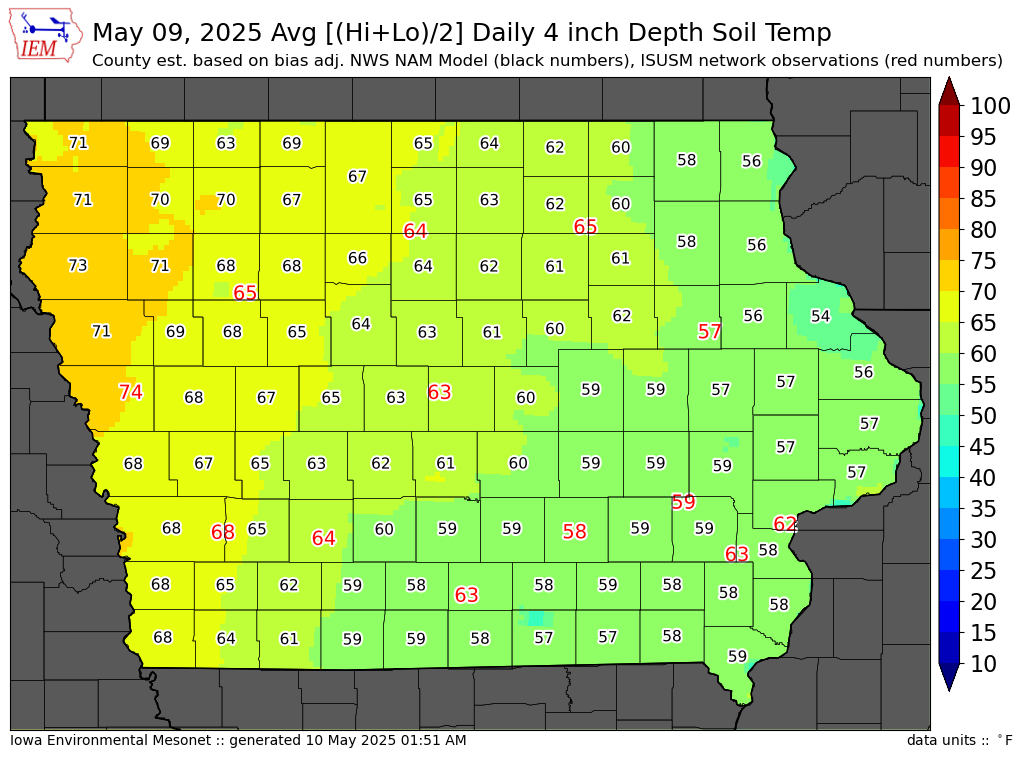
As a reminder, Iowa State University Extension and Outreach maintains a statewide real-time soil temperature data map on their website that ag retailers and farmers can use to determine when fall applications are appropriate. The website can be found at http://mesonet.agron.iastate.edu/data/soilt_day1.png. 

Tuesday, August 25, 2015

Can application of sand laden manure impact soil texture?

Soil texture and soil structure are properties of a soil that have major effects on a soils behavior, influencing important properties like the soil’s water holding capacity, its ability to retain and supply nutrients, the rate of water movement through the soil, and how much nutrient leaching will occur under different weather conditions.

Soil texture has is the relative proportions of sand, silt and clay sized particles in a soil. Knowing the amount of these particles in the soil lets us group the soil into a texture class. This has turned out to be extremely useful concept as just by knowing the textural class of a soil we understand many of its properties. For example sand instantly understand that the soil will have low water holding capacity, that water can move through it very quickly, and nitrogen will be very susceptible to leaching.

Of all the particles, clay tends to be the most important in determining the soil properties. This can be seen b examining the soil triangle as only about 25% of the soil needs to be clay to have “clay” included in the soils name, where as it takes 40-50% of the soil to have silt or sand included in the soil texture name. The reason this occurs is because the surface area of the particle has a major influence on this properties, and because clay sized particles are so much smaller than sand particles, the same mass of clay particles as sand will have more than a thousand times the total surface area of the particle.

 Soil structure refers to the arrangement of soil particles into groupings, or aggregates. Soil aggregation is an important indicator of workability to the soil and is often used synonymously with the term tilth. The type of structure that develops is dependent on lots of factors – the soil texture, the amount of organic matter, roots, and even the type of clay particles present.


So where am I going with this and how does it relate to manure? Well, this question came up because of sand bedding for dairy cows. The question was how does continually application of sand laden manure impact the soil and could it even change the texture?

So a few facts to get us started, the first thing question we need to know is how much soil is there in an acre? To make this calculation we need to know how deep we are considering, I’m going to pick 4 inches as most tillage equipment would work to this depth. Assuming a soil density of around 75 lb/ft3 (1.2 g/cm3) this means we’d have about 540 tons of soil in an acre.

The next question becomes how much manure are we going to put on and how often. Although its hard to pick a typical manure, I’d estimate sand laden dairy manure to be around 5 lb P2O5/ton and have about 300 lb of sand per ton. If I was applying to provide a year’s worth of P2O5 I’d want to put on around 60 lbs, which means I’d be applying about 12 tons of manure, or about 2 tons of sand per year. Will this impact my soil?

Say that our soil was a loam (20% clay, 40% silt, 40% sand). This means that right now my soil has 108 tons of clay, 216 tons of silt, and 216 tons of sand. If I added 2 tons of sand, my soil texture would change to 19.9% clay, 39.9% silt, and 40.2% sand; an imperceptible change (certainly not one we’d pick up by soil testing as the variability in collecting a sample is much larger than that). However, keep doing this for 84 years, and your soil texture would be 15% clay, 29% silt, and 56% sand – a sand loam soil.


Is this a long time, most certainly – is the soil better or worse than it was before? It’s hard, to say as it depends on longs of factors, like the soil texture we started with, our climate, our crop rotation, and what soil conditions the plant we are growing most prefers, but it is different. If you asked me if I was more concerned about adding two more tons of sand of soil to my acre of field or about losing two tons of soil to erosion, I’d most certainly be concerned about the erosion; however, it’s important to think about our soils long term and how we can best manage those resources to meet our production and sustainability goals.

Thursday, August 6, 2015

The Scoop on (Cow) Poop


I saw this video and had to share. It is well made and does a nice job illustrating the manure management side of farming.